Days system can run without sun.
Average effective full sun hours.
Lithium ≈ 80-90%, Lead-Acid ≈ 50%.
Extra capacity above peak load.
Wiring, heat, and conversion losses.
Choose a common panel size above or enter the exact wattage of your panel.
Optional: Specific Battery Sizing
Ready to Calculate
Enter your appliances and system preferences, then click "Calculate System Size" to see your complete off-grid solar system estimate.
What Is an Off-Grid Solar Calculator?
An off-grid solar calculator helps estimate the solar panel size, battery storage, inverter size, and daily energy demand for systems not relying on the utility grid. By inputting your specific appliances, their power ratings, and how long they run each day, the calculator determines the total energy required to keep your equipment running smoothly. It takes the guesswork out of sizing your solar array and battery bank, ensuring you have enough power during the day and sufficient storage for the night.
Who Should Use This Calculator?
This tool is designed for anyone planning an independent power system. Practical users include:
- Owners of cabins and holiday homes looking for reliable remote power.
- Farmers needing power for borehole pumps, electric fences, or outbuildings.
- Homeowners building completely off-grid houses.
- Tradespeople setting up remote workshops or site offices.
- Operators of small lodges or camping sites.
- Anyone designing backup systems where grid supply is highly unreliable.
Information You Need Before Sizing an Off-Grid Solar System
To get an accurate estimate, gather the following details about your power needs:
- List of appliances and equipment: Everything you plan to plug in.
- Watts or running power: The power draw for each item while operating.
- Hours used per day: A realistic estimate of daily runtime.
- Surge/start-up power: Extra power needed for motors and compressors to start.
- Daily energy use: Calculated in Wh or kWh based on watts and hours.
- Battery voltage: Typically 12V, 24V, or 48V depending on system size.
- Desired backup days: How many days the system must run without sun.
- Average sun hours: The effective peak sunlight hours in your location.
- Inverter efficiency: Accounting for power lost during DC to AC conversion.
- Battery depth of discharge: The safe usable percentage of your battery capacity.
Worked Example: Small Off-Grid Cabin
Let's calculate the daily energy needs for a basic off-grid cabin:
- LED lights: 60 W for 5 hours = 300 Wh
- Fridge: 120 W average for 8 hours = 960 Wh
- Laptop/charging: 100 W for 3 hours = 300 Wh
- Water pump: 500 W for 0.5 hours = 250 Wh
Total daily energy = 1,810 Wh or 1.81 kWh.
If the cabin needs 1.81 kWh per day and gets around 5 useful sun hours, the solar array must produce enough energy during the day to recharge the batteries and cover system losses. Furthermore, the battery storage must be large enough to support overnight use and provide power during cloudy days when solar production drops.
Why Battery Storage Matters
Solar panels only produce power during sunlight, but many essential loads—like fridges, lights, and routers—run at night or during cloudy weather. Because of this, battery storage must be sized for the actual usable energy needed, not just the printed capacity on the battery label. Several factors affect how much usable storage you actually have: battery chemistry (lithium vs. lead-acid), depth of discharge limits, ambient temperature, battery age, and inverter conversion losses. Sizing your battery bank correctly ensures you don't wake up in the dark.
Why Inverter Size Matters
Your inverter size must cover both your continuous running load and the start-up surge of your appliances. Motors, water pumps, fridges, freezers, compressors, and power tools can draw much more power during start-up than while running normally. A system that looks perfectly sized based on daily energy consumption can still fail and shut down if the inverter cannot handle the sudden surge demand when a pump or compressor kicks on.
Common Off-Grid Solar Sizing Mistakes
- Using appliance nameplate watts without checking real daily use.
- Forgetting start-up surge requirements for pumps, fridges, and compressors.
- Undersizing batteries for night use and cloudy days.
- Assuming all days have perfect, uninterrupted sunshine.
- Ignoring inverter efficiency and system wiring losses.
- Ignoring battery depth of discharge limits (especially with lead-acid batteries).
- Mixing old and new batteries incorrectly in the same bank.
- Not allowing capacity for future load growth or new appliances.
- Using too small cable sizes for high-current DC systems.
- Forgetting charge controller voltage and current limits.
- Not protecting batteries and electronics from extreme heat.
Planning Note: This calculator is a planning aid only. Users should verify final solar array size, battery bank capacity, inverter rating, charge controller specifications, cable sizes, protection devices, and installation requirements with a qualified solar installer or electrician before purchasing equipment.
Frequently Asked Questions
Related Calculators
Explore other tools to help with your solar system planning.
System-sizing formulas and safety limits
Formula: daily energy is Σ(watts×quantity×hours×duty cycle). Nominal battery energy = daily kWh×autonomy÷usable depth of discharge. PV array power = daily kWh÷peak-sun-hours÷(1−system loss). Inverter screening uses running and enabled surge loads plus the selected margin.
Verified example: a constant 100 W load for 5 hours uses 0.50 kWh/day. With 1 day autonomy and 80% depth of discharge, nominal storage is 0.625 kWh. At 5 peak-sun-hours and 25% loss, the array estimate is 133.3 W before panel rounding.
Safety: this is an energy-balance estimate, not a final PV design. A qualified designer must verify irradiance data, temperature-corrected PV voltage, MPPT limits, battery charge/discharge current, chemistry and BMS limits, fusing, isolators, earthing, cable ampacity and fire requirements using manufacturer data and local rules.
Authoritative references
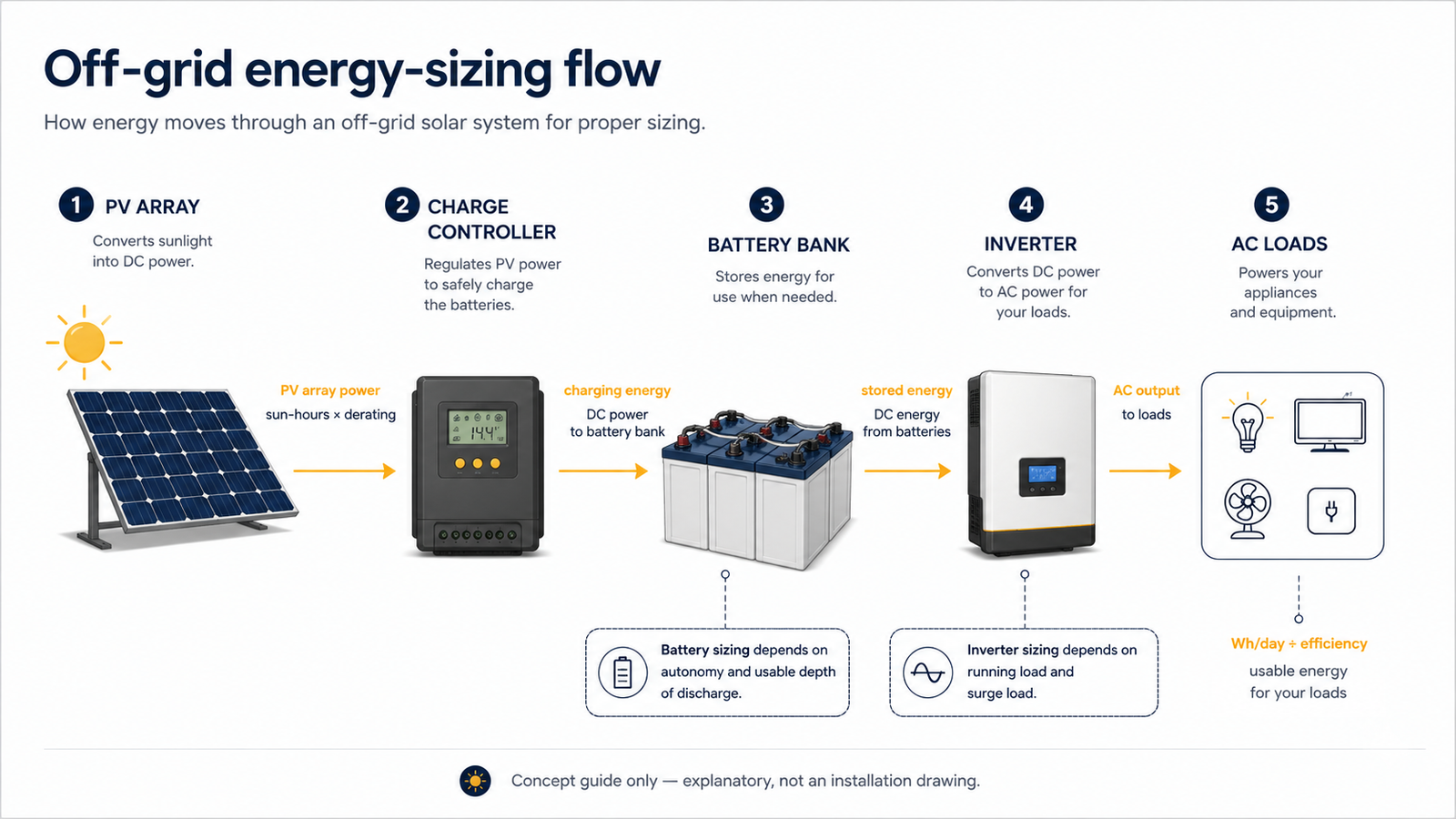
Off-grid energy-sizing flow
Use this guide to understand how the main parts of an off-grid solar system relate during system sizing. It shows the energy flow from the PV array through the charge controller, battery bank and inverter to the AC loads. This is an explanatory sizing guide, not an installation wiring diagram.