Motor Parameters
Enter your motor parameters
Select your calculation mode, input the voltage, power factor, efficiency, and motor power to generate electrical estimates.

Three-phase electric motor electrical characteristics and typical control panel connections
What this calculator does
This motor calculator accurately estimates electrical specifications for both three-phase and single-phase induction motors. It rapidly calculates motor current (Amps) from power (kW), determines power factor, and factors in motor efficiency. These calculations are crucial for properly sizing electrical cables, circuit breakers, and protection devices.
By estimating starting (inrush) currents and providing contactor sizing guidance based on AC-3/AC-3e ratings, it ensures safe installations that meet stringent electrical codes. It is widely used for industrial motors, HVAC systems, massive pumps, and air compressors.
Accurate calculation prevents dangerous overheating, cable insulation melting, and electrical fires. It provides essential data for industrial, commercial, and heavy agricultural applications.
Who should use it
This tool is designed for professionals working with heavy electrical machinery:
- Licensed Electricians: To properly size cables and breakers for new motor installations.
- Electrical Engineers: For panel design and specifying motor control centers (MCCs).
- Plant Maintenance Technicians: For troubleshooting and specifying replacement contactors.
- Industrial Contractors: For estimating installation requirements on factory floors.
- Facility Managers: To track electrical loads when adding new equipment.
- Motor Manufacturers & Suppliers: To quickly provide customer guidance on electrical requirements.
Formula or calculation method
For a three-phase motor, the core formula is: Current = Power / (Voltage × Power Factor × √3 × Efficiency). For a single-phase motor, the formula drops the √3: Current = Power / (Voltage × Power Factor × Efficiency).
Power factor accounts for the reactive power needed to magnetize the motor coils (typically 0.8 to 0.95). Efficiency varies heavily by motor type and size (usually 85% to 95%), accounting for mechanical and heat losses.
These calculations are vital for cable sizing. An undersized cable will overheat under full load, causing an immediate fire hazard. Motor nameplate data should always be used as the primary source of truth, but this calculator provides critical estimates when nameplates are unreadable or during the design phase.
Practical worked example
Let's calculate the current for a 10kW three-phase motor operating at 400V, with a power factor of 0.85 and 90% efficiency.
- Step 1: Convert kW to Watts.
10kW × 1000 = 10,000 W - Step 2: Calculate the denominator.
√3 (1.732) × 400V × 0.85 (PF) × 0.90 (Eff) = 529.99 - Step 3: Calculate full-load current (Amps).
10,000 W / 529.99 = 18.87 Amps
Sizing Implications: Based on 18.87A, a standard 2.5mm² or 4mm² copper cable might be selected (depending on length and installation method). A circuit breaker must be sized to handle the normal load, but its curve type (e.g., Type C or D) must allow for the massive starting current, which could surge to over 130A briefly.
Common mistakes to avoid
Ignoring power factor
Treating a motor like a pure resistive load (PF=1.0) calculates an artificially low current. This results in undersized cables and dangerous overheating.
Confusing single-phase and three-phase
Using the three-phase formula (with √3) on a single-phase motor will incorrectly estimate the current by a massive 73% margin.
Forgetting starting current
Direct-On-Line (DOL) motors pull 3 to 7 times their running current on startup. Breakers and contactors must be rated to handle this surge without tripping or welding shut.
Using nameplate power instead of actual load
A 10kW motor only draws 10kW of power if the mechanical load requires it. Sizing purely on nameplate kW when running empty over-estimates running current.
Running a 3-Phase Motor from a Single-Phase Supply
A three-phase induction motor can sometimes be operated from a single-phase supply using a suitable capacitor to create a phase shift. The correct motor terminal arrangement, voltage, capacitor selection and protection depend on the motor nameplate, winding configuration and intended load.
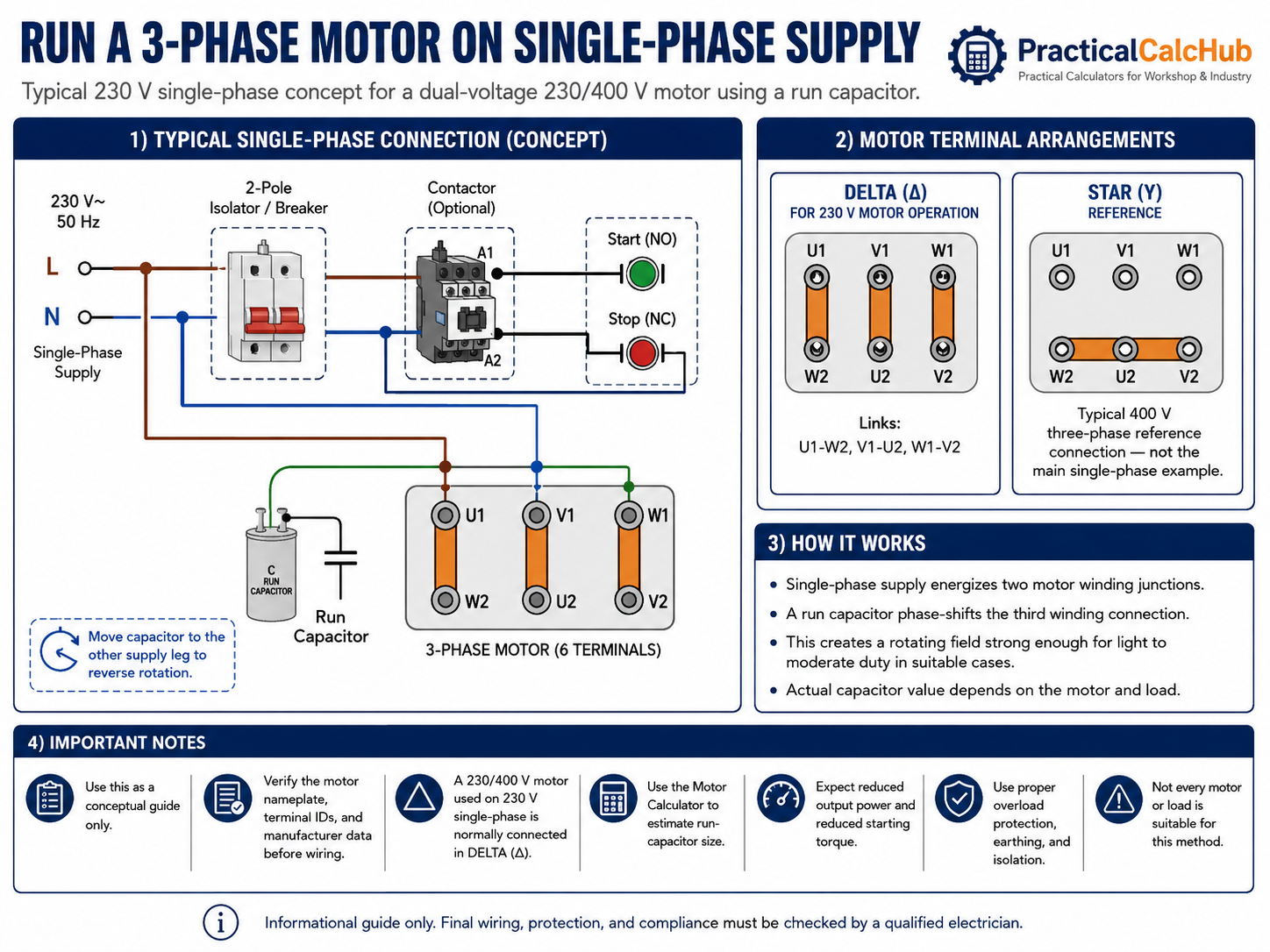
Important: Use the Motor Calculator above for capacitor estimation. Running a three-phase motor from single-phase power can reduce available starting torque and usable output. It is not suitable for every motor or load, and electrical modifications must be checked by a suitably qualified person.
Frequently Asked Questions
Related Calculators
Motor formula verification and limitations
Formula: three-phase current I = P/(√3×V×PF×η); single-phase current I = P/(V×PF×η). Reverse conversion multiplies measured current by the same voltage, power-factor and efficiency terms. Starting-current and capacitor figures are screening ranges, not nameplate or manufacturer selections.
Verified example: a 5 kW, 400 V three-phase motor at PF 0.85 and 90% efficiency gives 9.43 A. Direct-on-line screening at 5–7 times running current gives 47.17–66.04 A.
Safety: use the motor nameplate, manufacturer curves and locally adopted electrical rules for overloads, short-circuit protection, cable sizing, contactor utilization category, starting method and capacitors. Isolate and prove dead before electrical work; a qualified electrician must approve the installation.